Last updated June 21, 2026
Garage Door Repair Maintenance Checklist for Austin Homeowners
Of the last 200 emergency calls Paul Martin responded to across Austin — from Cedar Park to South Congress to Pflugerville — more than 60% traced back to one preventable problem: a worn or un-lubricated spring assembly that a 90-second monthly check would have flagged weeks before failure. Most homeowners assume the squeak or the slight hesitation is “just how it is.” It isn’t. Austin’s climate — triple-digit summers, fast humidity swings, and expansive clay soil that shifts foundation lines — puts mechanical stress on garage doors that a manufacturer’s generic PDF checklist was never designed to anticipate. This guide is built around what Paul actually sees on Austin service calls, ranked by how often each failure leads to an expensive emergency visit.
Quick Answer
A complete garage door maintenance routine for Austin homeowners covers six tasks performed on a monthly, seasonal, and annual schedule: a 90-second visual spring and cable inspection, lubrication with a heat-stable product, balance and auto-reverse safety tests, weatherstripping and seal checks, track alignment verification (critical in Central Texas where clay-soil foundation movement can shift door frames), and opener system review. Homeowners who follow this sequence — especially before March and October, Austin’s two highest-risk months for door failures — can avoid the majority of emergency repair costs, which typically run $180–$450 for spring and cable work in the Austin market.
Table of Contents
- The 90-Second Monthly Visual Inspection
- Lubrication: What Works in Austin’s Heat and What Doesn’t
- How to Check for Foundation-Movement Track Drift
- Seasonal Timing: Why March and October Are Your Highest-Risk Months
- Balance Test and Auto-Reverse Safety Check
- Weatherstripping, Seals, and Austin Weather Protection
- Opener and Drive System Maintenance
- DIY-Safe Tasks vs. Three Things You Should Never Touch Yourself
The 90-Second Monthly Visual Inspection
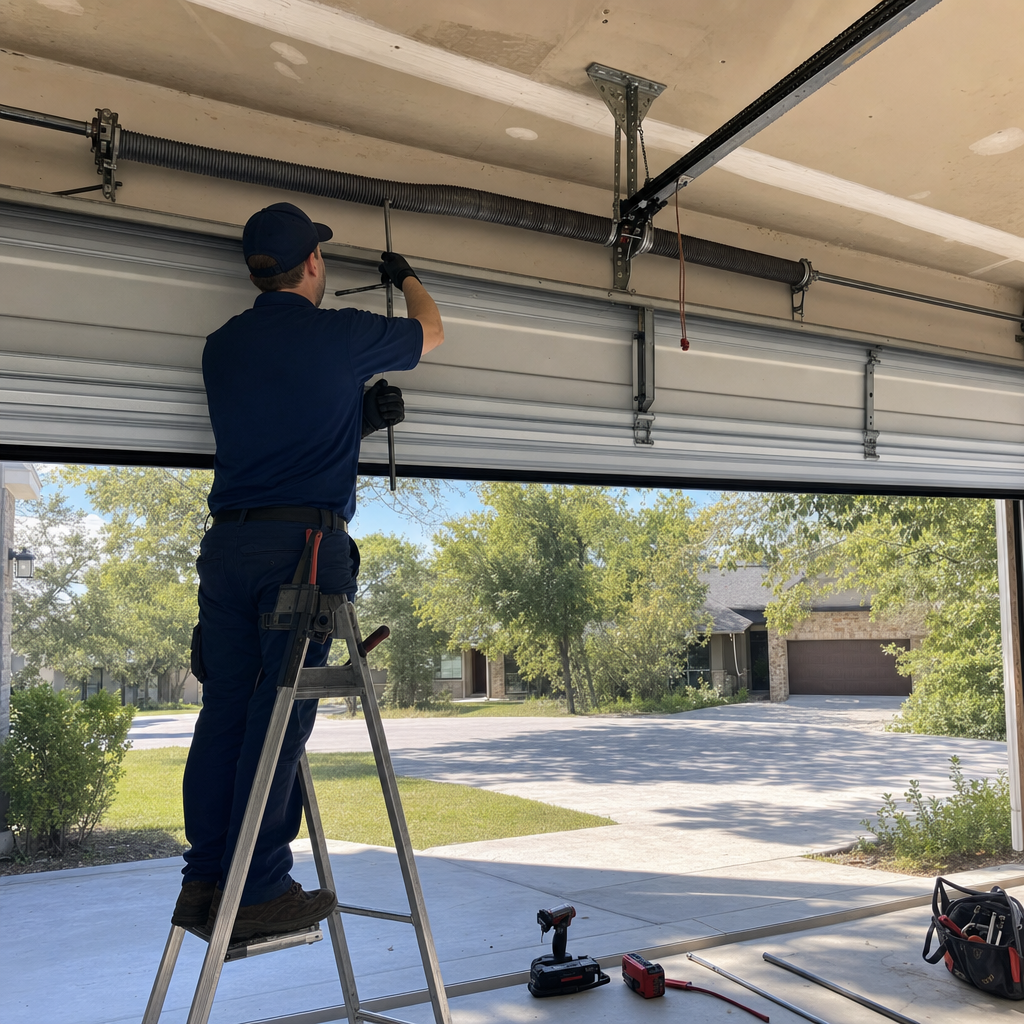
Most guides bury the spring check halfway down the page after telling you to wipe the door panels. We put it first because torsion and extension springs are the single most common cause of sudden, costly failure on Austin service calls — and spotting early warning signs costs you nothing but 90 seconds in your driveway.
Here’s the exact sequence Paul runs at the start of every maintenance visit:
- Look at the torsion spring above the door header (or the extension springs along the horizontal tracks if your door uses them). You’re looking for visible gaps in the coil — a gap of even a quarter-inch means the spring has broken or is close to it. Don’t operate the door if you see a gap.
- Scan the lift cables on both sides of the door. Cables run from the bottom bracket up to the spring drum. Look for fraying, kinking, or any cable that appears slack when the door is fully closed. A fraying cable in Austin’s heat will snap faster than you’d expect.
- Watch the door as it opens and closes one full cycle. It should move smoothly without jerking, grinding, or pausing mid-travel. Any hesitation in the top third of the travel arc is usually a spring tension or track issue.
- Listen. A rhythmic scraping sound usually means a roller is worn. A single loud pop means a spring or cable just let go — stop using the door immediately.
- Check the bottom of the door panels. Warping at panel joints is common in Austin’s summer heat, especially on older steel doors. Panel separation can stress the hinges and misalign the track over time.
Total time from start to finish: under two minutes. Do this the first weekend of every month and you’ll catch the majority of developing problems before they become emergency calls.
Lubrication: What Works in Austin’s Heat and What Doesn’t
This is where a lot of well-meaning homeowners make the problem worse. In Austin, where summer garage temperatures routinely hit 120°F inside an attached garage, the wrong lubricant will thin out, drip off moving parts, and leave a sticky residue that collects the fine clay dust Central Texas is known for. That gummy buildup on rollers and hinges acts like sandpaper over time.
Use this. Don’t use that.
- White lithium grease spray (aerosol, not paste): The right call for hinges, torsion spring coils, and the steel rollers on older doors. It stays in place through Austin summers and doesn’t run. We use this on the majority of residential doors we service.
- Silicone spray lubricant: Best for nylon rollers — it won’t degrade the nylon like petroleum-based products can. Also appropriate for the bottom weatherstrip track channel.
- WD-40: Not a lubricant for this application. It’s a water displacer and light solvent. In Austin’s heat, it evaporates quickly, leaves parts dry, and can actually strip away existing grease. We see WD-40 damage on rollers more often than any other DIY mistake.
- Spray grease “chain lube” products: Fine for chains and screws on opener drive systems, but too heavy for spring coils in extreme heat — they collect debris and build up into a gritty paste that increases wear.
What to lubricate and when:
- Torsion spring coils: Every 6 months (light coat of white lithium, wipe off excess)
- Hinges: Every 6 months or when squeaking begins
- Rollers (steel): Every 6 months; nylon rollers need silicone only
- Tracks: Do NOT lubricate the tracks themselves — debris sticks and causes more friction, not less. Clean them with a dry cloth instead.
- Lock mechanism and top of the rail on belt/chain drives: Annually
How to Check for Foundation-Movement Track Drift
This task appears on exactly zero national garage door maintenance checklists we’ve ever seen — and it’s one of the most important checks for Austin homeowners specifically. Central Texas sits on expansive limestone and clay-heavy soil that contracts during drought and expands after heavy rain. Austin’s intense summer drought cycles followed by fall rain events mean the soil beneath your home’s foundation is constantly in motion. Over years, that movement can shift door frames by a fraction of an inch — enough to throw your vertical tracks out of plumb.
A misaligned track doesn’t always fail dramatically. More often it causes subtle binding that strains your opener motor, accelerates roller wear, and eventually leads to a cable jumping its drum — which is a $200–$350 repair on average in the Austin market.
How to check track alignment yourself:
- With the door fully closed and disconnected from the opener (pull the red emergency release cord), manually lift the door to waist height and let go. A properly balanced, properly tracked door will hold its position without drifting up or down. If it drifts to one side, that’s a track alignment signal.
- Use a level on the vertical section of each track. Both should be plumb. A deviation of more than 1/8 inch is worth having a professional evaluate, especially if your home is in neighborhoods like Tarrytown, Rosedale, or Mueller where older foundations are more susceptible to movement.
- Visually inspect the gap between the door panels and the track. The gap should be uniform — typically around 1/4 inch — from top to bottom. A gap that widens or narrows along the track run indicates drift.
- Look at the lag bolts securing the track to the wall bracket. If any have pulled away from the framing — even slightly — the track has shifted and needs re-securing before further use.
If you find a significant misalignment, this is one of those three tasks below that should be handled professionally. Track adjustment involves repositioning under spring tension, which is not a safe DIY project.
Seasonal Timing: Why March and October Are Your Highest-Risk Months
Every spring manufacturer sets metal fatigue ratings for average temperature ranges. What no generic checklist accounts for is that Austin garage doors experience one of the most extreme thermal swing cycles in the country. From December to February, overnight temperatures regularly fall into the 30s and 40s. By June through August, the metal components in your garage door system are expanding in 100°F+ heat daily. That repeated expansion-contraction cycle stresses torsion springs and accelerates metal fatigue faster than a steady-temperature climate would.
March is high-risk because it’s the first period of rapid warming after winter’s cold. Springs that held on through the cold finally reach their fatigue limit when they’re asked to handle the expansion demands of warming metal — often during the first week of genuine spring heat. In our experience, March accounts for a disproportionate share of broken spring calls across Austin, Round Rock, and the surrounding communities we serve.
October is high-risk for the opposite reason. The first real cold fronts hit after months of sustained heat stress. The sudden contraction when temperatures drop from the 90s into the 60s overnight can be the final stressor on a spring that’s been working at its limit all summer. October and November combined represent the second-highest emergency call volume we see annually.
The pre-season maintenance schedule we recommend:
- Late February / Early March: Full lubrication service, spring tension check, balance test, weatherstrip inspection
- Late September / Early October: Repeat full lubrication, track alignment check, opener force settings test, seal check before the first cold front
- June (mid-summer check): Quick visual inspection of springs and cables; check that your opener’s thermal protection hasn’t tripped due to heat buildup
Balance Test and Auto-Reverse Safety Check
These are the two tests that directly protect your family, not just your door system. They take about four minutes combined and should be done every six months.
Balance Test (checks spring tension):
- Close the door fully and disconnect the automatic opener by pulling the red emergency release cord.
- Manually lift the door to about waist height (roughly 3–4 feet off the ground).
- Let go. The door should hold its position — or drift up or down only very slightly.
- If it falls quickly, the spring tension is too low. If it rockets upward, tension is too high. Either condition puts extra strain on every other component and will shorten the life of your opener motor.
- Reconnect the opener and schedule a spring tension adjustment. Don’t adjust spring tension yourself — this is one of the three professional-only tasks detailed below.
Auto-Reverse Safety Test (protects people and pets):
- Place a 2×4 board flat on the ground in the center of the door opening.
- Activate the door to close. When the door contacts the board, it should reverse direction within 2 seconds.
- If it doesn’t reverse, adjust the down-force sensitivity on your opener. On most LiftMaster and Chamberlain units, this is a sensitivity dial on the back or side of the motor unit. Genie and Craftsman models have similar controls — check your manual for the location.
- Also test the photo-eye sensors: with the door closing, break the beam with your hand or a broomstick. The door should immediately reverse. If the sensors are misaligned (common after lawn mowing season or after kids have been in the garage), the lights on the sensor brackets will blink rather than hold steady.
Federal law has required auto-reverse on all openers manufactured since 1993, but sensors drift and sensitivity settings change over time. Don’t assume yours still works correctly — test it.
Weatherstripping, Seals, and Austin Weather Protection
Austin gets a surprisingly wide range of weather for a Texas city — driving thunderstorms from March through May, triple-digit dry heat in summer, and occasional ice events in winter. Your door’s weatherstripping handles all of it, and it degrades faster here than in moderate climates because UV exposure is intense year-round.
Check these four seal points:
- Bottom seal (astragal): Should compress evenly against the floor when the door is closed. If you can see daylight, feel a draft, or notice the seal is cracking or brittle, replace it. In Austin, UV-degraded bottom seals are one of the leading causes of pest entry — a concern in neighborhoods near the Barton Creek Greenbelt and other wooded areas.
- Side seals (stop molding): Run your hand along the vertical edges of the door frame when the door is closed. Any air movement means the side seals need adjustment or replacement.
- Top seal: Often overlooked. Water intrusion at the top of the door during Austin’s heavy spring storms can warp the top panel on wood or fiberboard doors. Press the seal to confirm it’s making full contact.
- Panel joints (if applicable): On wood or insulated steel doors, check that the horizontal panel seals between sections haven’t cracked. In Austin’s summer heat, the compression foam between panels can flatten permanently after several years.
Replacement bottom seals for standard 16-foot two-car doors run $25–$60 in materials for most residential models. It’s one of the most cost-effective DIY maintenance tasks on this list.
Opener and Drive System Maintenance
Your opener gets opened and closed an average of 1,500 times per year in a typical household. In Austin, where many homeowners use the garage as the primary entry point due to the heat (avoiding the front door during summer months is a real behavioral pattern here), that number is often higher.
Monthly checks:
- Listen for unusual motor sounds: a grinding or buzzing at startup usually means the gear-and-sprocket assembly inside is worn.
- Check the drive system: belt drives should be taut with no visible cracking; chain drives should have about 1/2 inch of slack; screw drives need the least maintenance but should be lubricated with the manufacturer-specified grease annually.
- Test all wall control buttons and remotes. Intermittent response from a remote often means a low battery, but persistent issues on LiftMaster and Chamberlain systems can indicate antenna or logic board problems — which we see more frequently on openers over 10 years old.
Annual checks:
- Inspect all hardware connections at the trolley and header bracket for looseness.
- Test the manual disconnect to ensure it releases cleanly — this matters in a power outage.
- If your opener has a battery backup (standard on most current LiftMaster and Chamberlain models), verify the battery holds charge. Austin’s summer power fluctuations are hard on backup systems.
- Review the opener’s age. The average lifespan of a residential opener is 10–15 years. After 10 years, factor in replacement costs when budgeting repairs.
For a full assessment of your opener’s condition, our Garage Door Opener in Austin service page covers what we check and what replacement looks like when the time comes.
DIY-Safe Tasks vs. Three Things You Should Never Touch Yourself
One of the most useful things we can tell an Austin homeowner is where the line is — because crossing it can result in serious injury.
DIY-safe maintenance tasks:
- Visual inspection of springs, cables, rollers, and hardware
- Lubrication of hinges, rollers, and spring coils
- Balance test (lift and release only — no adjustments)
- Auto-reverse and photo-eye sensor tests
- Weatherstrip and seal replacement (bottom, side, and top)
- Cleaning tracks with a dry cloth
- Tightening loose nuts and bolts on hinges and brackets (hand-tight only)
- Replacing remote batteries and reprogramming remotes
Three tasks that require a professional — no exceptions:
- Torsion spring adjustment or replacement. A torsion spring stores hundreds of foot-pounds of energy when wound. An improperly handled spring can release that energy instantly. Paul has responded to injury calls that resulted from homeowners attempting this with YouTube guidance. The spring doesn’t care how careful you are — it cares about physics. This is non-negotiable.
- Cable replacement or re-routing. Lift cables are under tension when the door is closed and interact directly with the spring system. Replacing or re-routing them requires simultaneously managing spring tension, which is the same hazard as above. A misrouted cable will also cause immediate and expensive damage to other components.
- Track realignment under load. As covered in the foundation drift section, repositioning a vertical or horizontal track involves working adjacent to a tensioned spring system. The adjustment itself is straightforward for a trained technician — it’s the context that makes it dangerous without proper tools and experience.
For those three tasks, the cost of professional service ($120–$340 for most spring and cable work in Austin) is vastly less than the cost of a hospital visit or the collateral damage an improperly handled repair can cause to a door you might otherwise keep for 20+ years.
Common Mistakes to Avoid
- Using WD-40 as a lubricant. It’s a solvent, not a long-term lubricant. In Austin’s heat, it evaporates within days and can leave parts drier than before. Switch to white lithium grease or silicone spray depending on the component.
- Lubricating the tracks. Greasy tracks collect Austin’s clay dust and turn into an abrasive paste that grinds rollers down faster than no lubrication at all. Clean tracks, don’t grease them.
- Ignoring a “slightly off” balance. Homeowners in Westlake Hills and Steiner Ranch often tell us they “adjusted” to a door that opened a little slowly. A door that’s even slightly out of balance is overworking every mechanical component — and shortening the life of a $400 opener by years.
- Skipping the pre-season check in late February. Austin’s March spike in spring failures is predictable and preventable. A pre-season tune-up before the first hot week costs a fraction of an emergency spring replacement on a Saturday morning.
- Assuming a new door means no maintenance. We regularly see brand-new Clopay and Amarr doors on service calls for opener and hardware issues within the first two years — not because the door is defective, but because no maintenance routine was established. New doors still need lubrication, balance checks, and seal inspections.
- Over-tightening roller track bolts. Snugging up loose bolts is good. Cranking them with a socket wrench can strip the mounting holes in older door frames, especially in mid-century homes in Travis Heights and Hyde Park where the framing lumber has dried out significantly over decades.
- Waiting until the door won’t open to call. By the time a door stops functioning entirely, several components have usually already failed in sequence. The first sign — a new noise, a slight hesitation, a cable that looks slightly looser than it used to — is the right time to call, not when you’re locked out in 95°F heat.
When to Call a Professional
Call immediately — don’t continue using the door — if you notice any of the following:
- A visible gap in the torsion spring coil, or a spring that looks separated
- A frayed, kinked, or slack lift cable on either side of the door
- The door falls faster than it should when released from the balance test
- The auto-reverse function fails during your test
- The door tracks visibly bow, separate from the wall bracket, or show a gap of more than 1/4 inch
- The opener makes a grinding or burning smell during operation
- The door won’t stay in the raised position when the opener is disconnected
For any of these situations, Garage Door Repair in Austin is what we do every day — including emergency calls when a door fails at the worst possible time. Paul Martin and his team offer free estimates across Austin. Call (737) 210-3210 and you’ll typically reach Paul directly, not a call center.
Frequently Asked Questions
Lubricate your springs, hinges, and rollers every six months in Austin — specifically in early March and early October before the major seasonal temperature shifts. Austin’s heat causes lubricants to break down faster than in moderate climates, so the standard “once a year” recommendation from most manufacturer guides isn’t adequate here. Use white lithium grease on metal components and silicone spray on nylon rollers. Call (737) 210-3210 for a free estimate if you’d like us to handle lubrication as part of a full tune-up.
Torsion spring replacement in Austin typically runs $180–$340 for a single spring, including labor and the new spring hardware. If both springs need replacement — which we usually recommend doing simultaneously since they wear at the same rate — expect $250–$420 depending on the spring size and door weight. Extension spring replacement on lighter doors typically costs $120–$220. These ranges reflect current Austin market pricing; always get a written estimate before authorizing the work. Call (737) 210-3210 for a no-pressure quote.
Yes — this is one of the most Austin-specific issues we deal with. Expansive clay soil causes the foundation slabs common in Central Texas to shift seasonally, and that movement can transfer to the door frame over time, pulling vertical tracks slightly out of plumb. We see this most often in homes built before 1990 in neighborhoods like Allandale, Crestview, and South Lamar, but newer construction isn’t immune. If your door has started binding or running unevenly and your home is more than 10 years old, a track plumb check is worth adding to your annual inspection.
A tune-up is proactive — lubrication, hardware tightening, balance and safety tests, and a full visual inspection before anything breaks. It typically costs $79–$129 in Austin and takes about 45 minutes. An emergency repair is reactive — a spring has broken, a cable has snapped, or the door won’t move — and costs significantly more, both in parts and in the stress of dealing with it at an inconvenient time. The tune-up pays for itself the first time it catches a developing spring failure.
No — stop using the door immediately if you see any gap in the torsion spring coil. Even a small gap means the spring has fractured or is on the verge of complete failure. Operating a door with a broken spring puts extreme stress on the lift cables, the opener motor, and the trolley, and creates a real risk of the door dropping unexpectedly. Disconnect the opener, use your home’s front or side door, and call (737) 210-3210 to schedule a same-day repair.
If your opener is under 8 years old and the issue is isolated — a worn gear, a faulty circuit board, a stripped drive — repair is almost always more cost-effective. If it’s over 10–12 years old and you’re looking at a second repair within 18 months, replacement often makes more financial sense, especially since newer LiftMaster and Chamberlain units come with battery backup and smartphone integration that older units lack. Our Garage Door Opener in Austin page covers what a full opener replacement looks like and what we typically recommend for Austin’s heat environment.
The Bottom Line
Garage door maintenance in Austin isn’t complicated, but it has to be calibrated for this specific climate — the heat, the clay soil, the rapid seasonal swings. The homeowners who avoid expensive emergency calls are the ones who spend 90 seconds looking at their springs every month, lubricate with the right products twice a year, and schedule a professional check before March and October. The ones who call Paul for emergency service on a Sunday afternoon are usually the ones who noticed something slightly off three months earlier and figured it could wait. It almost never can. Build the habit, use this checklist, and your door will run reliably for years longer than average. For anything that crosses into professional territory, Total Garage Door Experts Austin is here — free estimates, no runaround, and usually Paul himself on the job.
Ready to schedule a tune-up or get a free estimate on a repair? Call (737) 210-3210 — you’ll get a straight answer from someone who’s worked on garage doors in Austin for 12 years and has the 1,212 reviews to back it up.
If you’re weighing whether to repair or replace your current door entirely, our Garage Door Installation in Austin page walks through what a full replacement costs and which door systems hold up best in Central Texas conditions.
Written by Paul Martin, Owner & Lead Technician at Total Garage Door Experts Austin, serving Austin since 2014.