Last updated June 21, 2026
The Complete Guide to Garage Door in Austin
Austin’s expansive clay soil shifts up to 4 inches seasonally — and most homeowners don’t realize that’s what’s throwing their garage door out of alignment every spring. That single geological fact explains more Austin-area service calls than any mechanical failure we’ve seen in 12 years of turning wrenches across this city. This guide was built specifically for Central Texas homes, not repurposed from a generic national template. By the time you finish reading, you’ll understand how Austin’s climate, soil, housing stock, and local code requirements shape every garage door decision — from choosing the right material to knowing when a repair has crossed into permit territory.
Quick Answer
A garage door in Austin, TX is a system that’s uniquely stressed by Central Texas conditions: clay soil movement, intense UV exposure, humidity swings, and occasional hard freezes all accelerate wear faster than in more stable climates. The most important things Austin homeowners need to know are which materials hold up best in this climate, how seasonal soil shifts affect door alignment, and when to repair versus replace. For specific pricing or same-day service, call (737) 210-3210 — estimates are always free.
Table of Contents
- How Austin’s Clay Soil Affects Your Garage Door
- Material Performance in Austin’s Climate
- Neighborhood-Specific Considerations Across Austin
- The Most Common Garage Door Failures We See in Austin
- Austin Building Permits: What Requires One and What Doesn’t
- Repair vs. Replace: How to Decide in the Austin Market
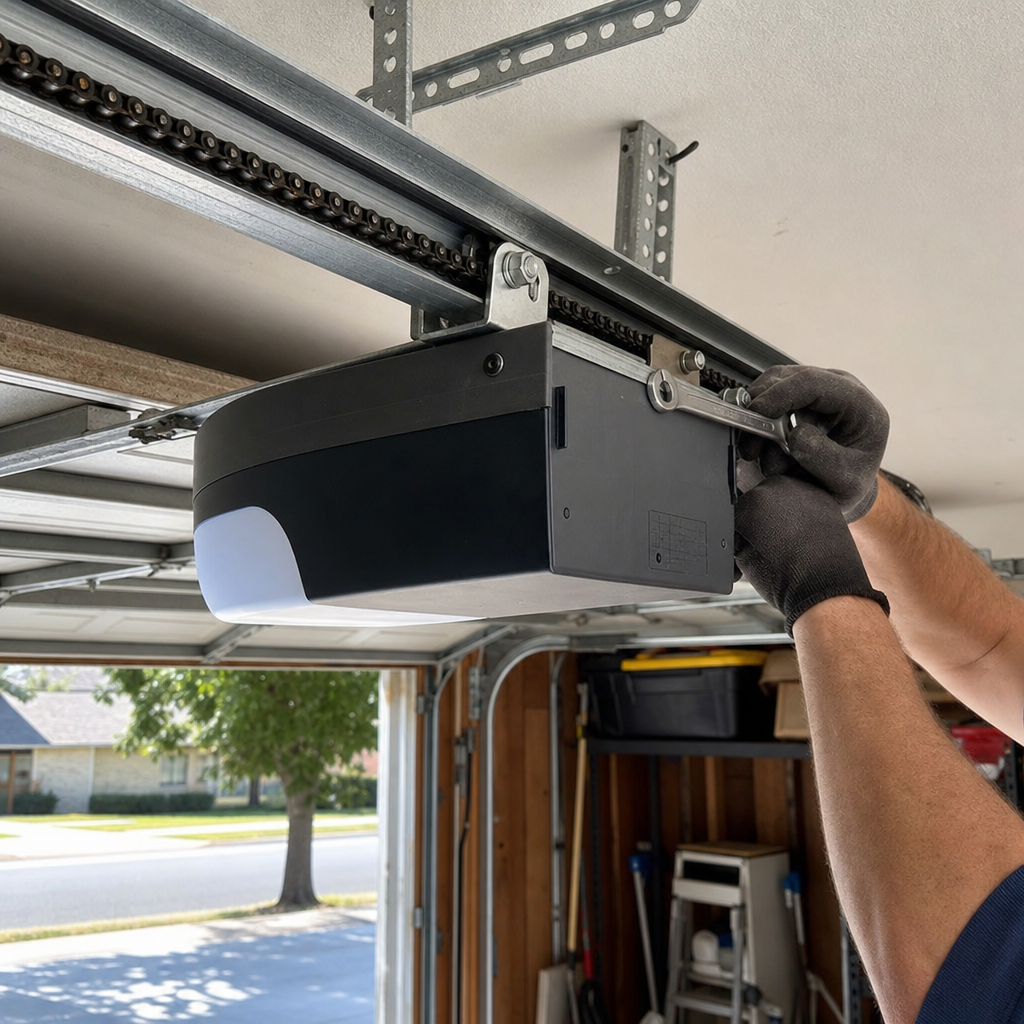
- Choosing the Right Garage Door Opener for Austin Homes
- Common Mistakes to Avoid
How Austin’s Clay Soil Affects Your Garage Door
Austin sits on a swath of expansive Blackland Prairie clay that behaves almost like a living organism. During dry summers, the soil contracts and pulls away from foundations. After heavy rains — or a wet spring like Austin regularly gets — it swells back. That cycle exerts lateral and vertical pressure on concrete slabs and garage floor aprons that most homeowners never connect to their door problems.
What does that look like in practice? We regularly see these symptoms in Austin homes after the soil has shifted:
- Uneven gaps along the bottom of the door, often wider on one side than the other
- Track misalignment that causes the door to bind or reverse unexpectedly mid-travel
- Frame racking, especially in older homes where the rough opening isn’t bolted to a reinforced header
- Weatherstripping failure on one side while the opposite side still seals fine
- Spring tension drift — because when a door sits slightly out of level, the torsion spring works harder on one side
This is genuinely different from what happens in, say, Dallas or San Antonio, where soil types vary. In North Austin neighborhoods like Round Rock-adjacent subdivisions built on slab foundations, we see more dramatic seasonal shifts than in South Austin homes on pier-and-beam construction, where the foundation itself has some give. The fix isn’t always the door — sometimes it’s adjusting the track to compensate for a floor that’s moved a quarter-inch. That’s a diagnostic call that takes experience to make correctly.
In our experience, Austin homeowners who schedule a spring tune-up after the first major rain of the season catch these alignment issues before they become spring failures or cable snaps.
Material Performance in Austin’s Climate
Austin’s climate is genuinely punishing on building materials. You’re dealing with 100°F-plus summers, UV intensity that fades and degrades surface finishes faster than the national average, relative humidity that swings from the mid-30s in a dry July to the 90s during a Gulf moisture surge, and occasional hard freezes that can crack vinyl and seize hardware lubricated with the wrong grease. Here’s how the four primary garage door materials hold up:
Steel
Steel is the dominant material in Austin’s market for good reason — it handles temperature extremes well, doesn’t warp, and holds paint finishes reliably when properly primed. The weak point is the bottom section: Austin’s clay-related moisture retention at the slab level accelerates rust on unpainted or scratched bottom edges. Insulated steel doors (two-layer or three-layer construction) are worth the investment here because they moderate the temperature differential between the garage interior and the door skin, which reduces condensation-driven corrosion from the inside.
Wood
Solid wood doors look stunning on the cedar-shake craftsman bungalows in Travis Heights and Bouldin Creek, and they’re not impossible to maintain in Austin — but they demand more attention than in drier climates. The humidity swings cause wood to expand and contract seasonally, which means paint cracks, gaps appear at panel joints, and hardware loosens over time. If you want the wood aesthetic, engineered wood composite (like Wayne Dalton’s composite series) gives you most of the look with far better dimensional stability.
Fiberglass and Vinyl
Fiberglass holds color better than vinyl under Austin’s UV load but can become brittle in hard freezes — a real consideration given that Austin sees subfreezing temperatures roughly 20–30 days per year on average. Vinyl is low-maintenance but fades noticeably within 5–7 years on west- or south-facing garages. Neither is the first recommendation for most Austin homes unless aesthetics or salt-air proximity is a factor.
Aluminum
Aluminum is lightweight, rust-proof, and works well for modern design homes in neighborhoods like Mueller or East Cesar Chavez. It dents more easily than steel, but it doesn’t corrode, which matters in Austin’s occasionally humid microclimate near creeks and low-lying areas.
Neighborhood-Specific Considerations Across Austin
Austin is not a monolithic housing market — door size standards, framing practices, and aesthetic norms vary significantly by neighborhood age and construction era.
Older East Austin and South Austin (Pre-1980 Homes)
Homes in 78702, 78704, and surrounding zip codes were often built to different rough opening standards than modern construction. Many older East Austin bungalows have single-car openings that are non-standard widths — 8’6″ or 9’0″ instead of the modern 9’0″ or 10’0″ standard. Replacing a door here often means custom sizing or careful header work to standardize the opening. The framing in these homes is also more likely to have settled, meaning the rough opening itself needs to be checked for square before a new door is hung.
Newer North and Northeast Austin Subdivisions (Pflugerville, Hutto-Adjacent)
Subdivisions built in the 2005–2020 era around Pflugerville and North Austin typically have standard two-car 16’x7′ openings and modern framing — replacements here are more straightforward. However, these neighborhoods sit on some of the most active Blackland clay in the metro, so track alignment complaints are especially common. HOA guidelines in many of these communities also restrict door colors and materials, so check your CC&Rs before ordering.
West Austin and Lake Travis Area
Homes in 78733, 78746, and the Lake Travis corridor tend to be higher-end construction with larger openings (18’x8′ or even 20’x8′ for RV bays) and thicker, insulated door specifications. The hill country terrain here means less clay-related movement but more exposure to limestone-dust environments that abrade bottom seals faster than average.
Downtown Condos and Urban Infill
Newer infill construction in 78701 and nearby zip codes increasingly features alley-loaded garages and carriage-house style doors. These installations often require quieter, DC-motor openers — neighbors are close — and the narrow alley clearances demand careful headroom measurement before specifying a door opener rail system.
The Most Common Garage Door Failures We See in Austin
Twelve years of Austin service calls reveal patterns that generic guides miss. Here are the failure points we diagnose most often in this specific market:
- Torsion spring failure — The single most common call. Austin’s temperature cycling (extreme heat followed by occasional hard freezes) fatigues spring metal faster than in moderate climates. Most springs are rated for 10,000 cycles; we’ve seen Austin springs fail at 7,000–8,000 cycles on doors that see hard daily thermal swings.
- Track misalignment from soil movement — As described above, this is uniquely Austin. The door binds, reverses, or makes a grinding noise, and the homeowner assumes the opener is failing. Often it’s the track that’s moved a fraction of an inch.
- Bottom weatherseal deterioration — Austin’s summer heat literally bakes rubber seals. A seal that would last 5–6 years in Denver lasts 3–4 years in Austin. Cracked or compressed seals let in water, pests, and conditioned-air loss.
- Opener logic board failures after power surges — Austin gets intense thunderstorm seasons. Openers without surge protection (or plugged into unprotected outlets) take repeated voltage spikes that fry logic boards. We see this cluster heavily in March–May and September–October.
- Cable fraying on doors left in the open position during summer — Homeowners who leave their door open for extended periods in Austin’s summer heat to ventilate the garage often introduce accelerated cable oxidation from humidity. The cables sit at full tension in the open position, and the moisture accelerates surface rust at the anchor point.
- Panel warping on south-facing wood and composite doors — South-facing garage doors in Austin see direct midday sun for 6–8 hours a day in summer. Thermal expansion on the exposed face versus the shaded interior face creates bow stress that eventually cracks panel joints.
Austin Building Permits: What Requires One and What Doesn’t
This is one of the most-searched questions we get from Austin homeowners, and the answer matters because unpermitted work can create issues at resale and may void your homeowner’s insurance coverage for related claims.
Permit Generally NOT Required
- Like-for-like door replacement (same size, same location, no structural changes)
- Garage door opener replacement or installation
- Spring, cable, roller, or hardware repairs
- Weatherstripping or bottom seal replacement
Permit Generally REQUIRED
- Widening or enlarging the garage door opening
- Adding a new garage door opening where none existed
- Structural header modifications to accommodate a larger door
- Converting a garage space into living area (which involves the door opening)
The City of Austin Development Services Department handles residential permits. For a standard garage door enlargement project, plan for a building permit application, a structural review if the header is being modified, and a post-installation inspection. Processing times vary — budget 2–4 weeks for a standard residential permit in current Austin permitting timelines. When Paul and his team are involved in any work that approaches permit territory, we’ll tell you upfront and clearly before a single bolt is touched.
Repair vs. Replace: How to Decide in the Austin Market
This is the decision that generates the most uncertainty for Austin homeowners, and it’s one where honest advice from a non-commission-driven technician matters. Here’s the framework we walk customers through:
Lean Toward Repair When:
- The door is under 10 years old and structurally sound
- The issue is isolated — one broken spring, a snapped cable, a bent roller
- The door panels are undamaged and the insulation rating still meets your needs
- The repair cost is under 40–50% of a comparable replacement door
Lean Toward Replacement When:
- The door is 15–20+ years old and showing multiple failure points simultaneously
- Multiple panels are dented, cracked, or warped — patching one rarely looks right against weathered surrounding panels
- The door’s insulation value (R-value) is poor and you’re paying to air-condition a garage that bleeds heat through a single-layer steel door in Austin’s summer
- You’re planning to sell the home — garage door replacement consistently ranks among the highest ROI home improvement projects, and Austin’s competitive real estate market makes curb appeal matter
For a deeper look at when replacement makes financial sense, our Garage Door Installation in Austin page walks through door grades, pricing tiers, and what to expect from the installation process.
Choosing the Right Garage Door Opener for Austin Homes
The opener market has changed significantly in the last five years, and Austin homeowners have specific considerations that influence the right choice.
Drive Type
- Belt drive — Our most-recommended type for Austin’s urban and suburban homes. Quiet operation matters when garages are attached to living spaces, and belt drives handle Austin’s temperature range reliably.
- Chain drive — Durable and affordable, better suited for detached garages where noise isn’t an issue. Common in older East Austin properties.
- Jackshaft/wall-mount — Ideal for Austin’s newer construction with low-clearance or high-ceiling garages, and increasingly popular in the Mueller and Domain-area urban homes where ceiling obstructions are common.
- Direct drive (screw drive) — Has fewer moving parts, but temperature sensitivity makes it a less consistent performer in Austin’s wide seasonal temperature range.
Smart Features
LiftMaster’s myQ platform and Chamberlain’s connected openers have become near-standard requests in Austin’s tech-forward homeowner base. Battery backup is worth prioritizing — Austin sees power outages during ice storms (February 2021 remains fresh in residents’ memory) and during peak summer thunderstorm season. An opener without battery backup leaves you manually lifting a heavy door during an outage.
For a complete breakdown of opener types, brands, and pricing, visit our Garage Door Opener in Austin page.
Common Mistakes to Avoid
- Ignoring seasonal alignment checks after Austin’s wet season. The spring rains that swell Austin’s clay soil are the most predictable cause of track misalignment we see all year — scheduling a quick inspection in April or May catches problems before they become emergency calls.
- Using the wrong lubricant on tracks and springs. WD-40 is a solvent, not a lubricant, and it attracts the fine limestone and cedar dust common in Austin’s air. Use a silicone-based spray or white lithium grease on rollers and hinges, and a dedicated garage door lubricant on springs.
- Choosing door material based on aesthetics alone without accounting for orientation. A beautiful wood-look composite door on a south-facing Austin garage will look weathered within 3–4 years without the right UV-resistant finish. Ask about finish warranties before you decide.
- Assuming the opener is the problem when the door binds. At least 30% of Austin “my opener stopped working” calls we receive turn out to be track or spring issues that put load on the opener until it trips the safety mechanism. The opener is protecting itself — the door is the root cause.
- Skipping surge protection for the opener. Austin’s spring and fall thunderstorm seasons are intense. A $15–$25 surge-protected outlet strip or a hard-wired surge suppressor on the opener circuit is cheap insurance against a $200–$400 logic board replacement.
- Attempting DIY torsion spring replacement. Torsion springs store enormous mechanical energy. We’ve seen serious injuries result from attempted DIY spring replacements across Austin — this is one of the few tasks where the risk genuinely outweighs the savings, regardless of your mechanical skill level.
- Ordering a replacement door without measuring the rough opening post-soil-shift. Austin homeowners who measure their opening once and order a door without re-measuring after a wet season can end up with a door that doesn’t fit cleanly. Always measure twice, and measure after the soil has settled.
When to Call a Professional
Some garage door tasks are legitimate DIY territory: lubricating hinges, replacing weatherstripping, reprogramming a remote. Others cross a line where doing it yourself creates real risk or can make the problem worse.
Call a professional when:
- A torsion or extension spring has broken — the spring is under high tension even when the door is closed
- The door came off its tracks or a cable snapped
- The door won’t fully close and you’re not sure why — leaving it ajar overnight in Austin is a security problem
- You’re hearing grinding, popping, or metal-on-metal sounds during operation
- The door reverses randomly or doesn’t respond consistently to the opener
- You’re replacing the door entirely and need framing or header assessment
Total Garage Door Experts Austin offers free estimates on all repair and installation work. Paul Martin handles diagnostics personally — you get the owner’s read on your situation, not a salesperson’s pitch. Call (737) 210-3210 for same-day or emergency service anywhere in the Austin area.
Frequently Asked Questions
Most garage door repairs in Austin fall between $120 and $450, depending on what’s broken. A single torsion spring replacement typically runs $180–$280; cable replacement runs $130–$210; roller replacement is $95–$160; and opener logic board repair or replacement ranges from $180–$380. Emergency or same-day service may carry a service call premium. For an exact quote with no obligation, call (737) 210-3210 — estimates are free.
Yes — and more directly than most homeowners expect. Austin’s Blackland Prairie clay shrinks and swells seasonally by up to 4 inches, which shifts concrete slab aprons and garage floor slabs enough to pull tracks out of plumb. The result is a door that binds, reverses unexpectedly, or develops uneven gaps along the bottom seal. This is one of the most Austin-specific failure patterns we diagnose regularly, and it’s almost never covered in national garage door guides.
Yes — same-day and emergency service are available throughout the Austin area. Paul Martin’s direct involvement means scheduling decisions aren’t filtered through a dispatch call center. If your door is stuck open, stuck closed, or off its tracks, call (737) 210-3210 and we’ll tell you honestly what the fastest available window looks like. We stock parts for all major brands — LiftMaster, Clopay, Amarr, Wayne Dalton, Genie, Chamberlain, Craftsman, and Raynor — which means most repairs are completed in a single visit.
A like-for-like door replacement — same size, same location, no structural modifications — does not require a permit in Austin under current City of Austin Development Services guidelines. However, if you’re widening the opening, modifying the header, or adding a new opening where none existed, a building permit is required. When in doubt, we’ll tell you before the job starts — unpermitted structural work creates real problems at resale.
Insulated steel is the most practical choice for the majority of Austin homes. It handles temperature extremes without warping, resists UV degradation better than vinyl or fiberglass, and the insulation layer moderates condensation that accelerates rust on south- and west-facing doors. Wood and wood-composite options are beautiful but require more maintenance in Austin’s humidity-swing environment. For a full breakdown by orientation and neighborhood, see the material performance section above.
Repair wins when the door is under 10–12 years old and the damage is isolated. Replacement makes more financial sense when the door is 15+ years old, multiple panels are damaged, or the repair cost approaches 50% of a new door’s price. In Austin’s real estate market, a new garage door also carries strong curb appeal value — it’s one of the few home improvements where the ROI consistently exceeds the cost at resale. Our Garage Door Repair in Austin page covers repair cost thresholds in more detail. Still unsure? Call (737) 210-3210 for a free on-site assessment.
The Bottom Line
Austin’s garage doors face a specific combination of challenges — clay soil movement, UV intensity, temperature extremes, and aging housing stock — that national guides simply don’t address. Understanding those local factors is the difference between a repair that holds and one that fails again in six months. Whether you’re diagnosing an alignment problem in a South Austin bungalow, choosing materials for a new Pflugerville build, or navigating the permit question on an East Austin remodel, the decisions are easier when you know what you’re actually dealing with. For anything beyond basic maintenance, the Total Garage Door Experts Austin home is the starting point for service, estimates, and honest advice from a technician who’s been working Austin doors specifically for 12 years.
Ready to talk through your specific situation? Call Paul and his team at (737) 210-3210 — free estimates, same-day availability, and straight answers from someone who actually knows Austin’s doors.
Written by Paul Martin, Owner & Lead Technician at Total Garage Door Experts Austin, serving Austin since 2014.