Last updated June 21, 2026
Seasonal Garage Door Care for Austin: Year-Round Homeowner’s Guide
Here’s something most Austin homeowners don’t expect: garage door failures spike in October, not July. After five months of 100°F heat baking the hardware, the first cold snap hits metal that hasn’t been lubricated since spring — and that’s when springs snap, rollers seize, and openers start acting up. Austin’s climate doesn’t follow the four-season pattern that most maintenance guides are written for. We deal with sustained UV punishment, rapid temperature swings, a dry-winter freeze window, and two storm seasons that can send 70 mph winds through a neighborhood in under 20 minutes. This guide walks you through the actual maintenance calendar Austin demands.
Quick Answer
Austin garage doors need maintenance on a four-point schedule tied to the city’s actual weather patterns: pre-storm prep in April, heat hardening in June, freeze prep in November, and a post-freeze inspection in February. Skipping any one of these windows — especially the November lubrication before the first cold snap — is the single most common reason Austin homeowners face an emergency repair. A complete annual tune-up from a local professional typically runs $80–$150 and can prevent repairs costing three to five times that amount.
Table of Contents
- Austin’s Actual Seasons: What Your Garage Door Faces All Year
- April: Pre-Storm-Season Prep
- June: Peak-Heat Hardening
- November: Freeze Prep
- February: Post-Freeze Check
- UV Degradation: Austin’s Hidden Weatherstripping Problem
- The One Task After Every Major Temperature Swing
- Common Mistakes to Avoid
- When to Call a Professional
- Frequently Asked Questions
- The Bottom Line
Austin’s Actual Seasons: What Your Garage Door Faces All Year
Standard seasonal maintenance guides divide the year into spring, summer, fall, and winter. That framework doesn’t fit Central Texas, and following it blindly leaves real gaps in your garage door’s care. What Austin actually delivers is closer to this:
- Heat season (June–September): Sustained temperatures above 95°F, UV index regularly hitting 10–11, and thermal expansion stress on every metal component.
- Storm windows (April–May and September–October): Two periods when atmospheric conditions produce severe thunderstorms and derecho-style straight-line wind events that can exceed 70 mph.
- Brief, sharp winter (November–February): Mild most days, but punctuated by sudden freezes — sometimes dropping 40°F in under 48 hours — that stress torsion springs, bottom seals, and opener logic boards in ways that don’t affect climates with gradual seasonal transitions.
- Dry shoulder seasons (March and October): Transition periods with the widest daily temperature swings and the highest mechanical fatigue risk.
In 12 years of garage door work across Austin — from Mueller and East Cesar Chavez to Steiner Ranch and South Lamar — Paul Martin has watched this pattern produce four predictable failure windows every year. The maintenance schedule in this guide is built around those windows, not around a calendar that was written for Ohio.
April: Pre-Storm-Season Prep
Austin’s first serious storm window opens in April. Unlike Gulf Coast hurricane prep, which focuses on long-duration wind loads and water intrusion, Central Texas storm prep is about short, violent events. Derechos and severe squall lines can hit Austin with 60–75 mph straight-line winds that arrive with almost no warning. A garage door that’s loose in its tracks, missing lag bolts in the bracket, or running on worn rollers becomes a structural liability in those conditions.
Here’s what to check before April’s storm season arrives:
- Inspect the horizontal and vertical tracks for gaps at the seams and loose mounting bolts. Tracks that have shifted even a quarter inch can allow the door to rack under lateral wind pressure.
- Check all lag screws on the header bracket and spring anchor plate. These are the anchor points that keep the door assembly connected to your framing. If the wood behind them has softened from moisture, they’ll strip out under a wind load.
- Test the door’s manual lock bar if your door has one. In a power outage during a storm, this is your primary mechanical security. Many homeowners haven’t engaged it in years and don’t know it’s seized.
- Confirm the bottom seal is continuous and seated. Gaps let wind-driven rain in at the floor level — one of the most common post-storm complaints we see in neighborhoods like Onion Creek and Slaughter Lane, which sit in lower-elevation areas prone to runoff.
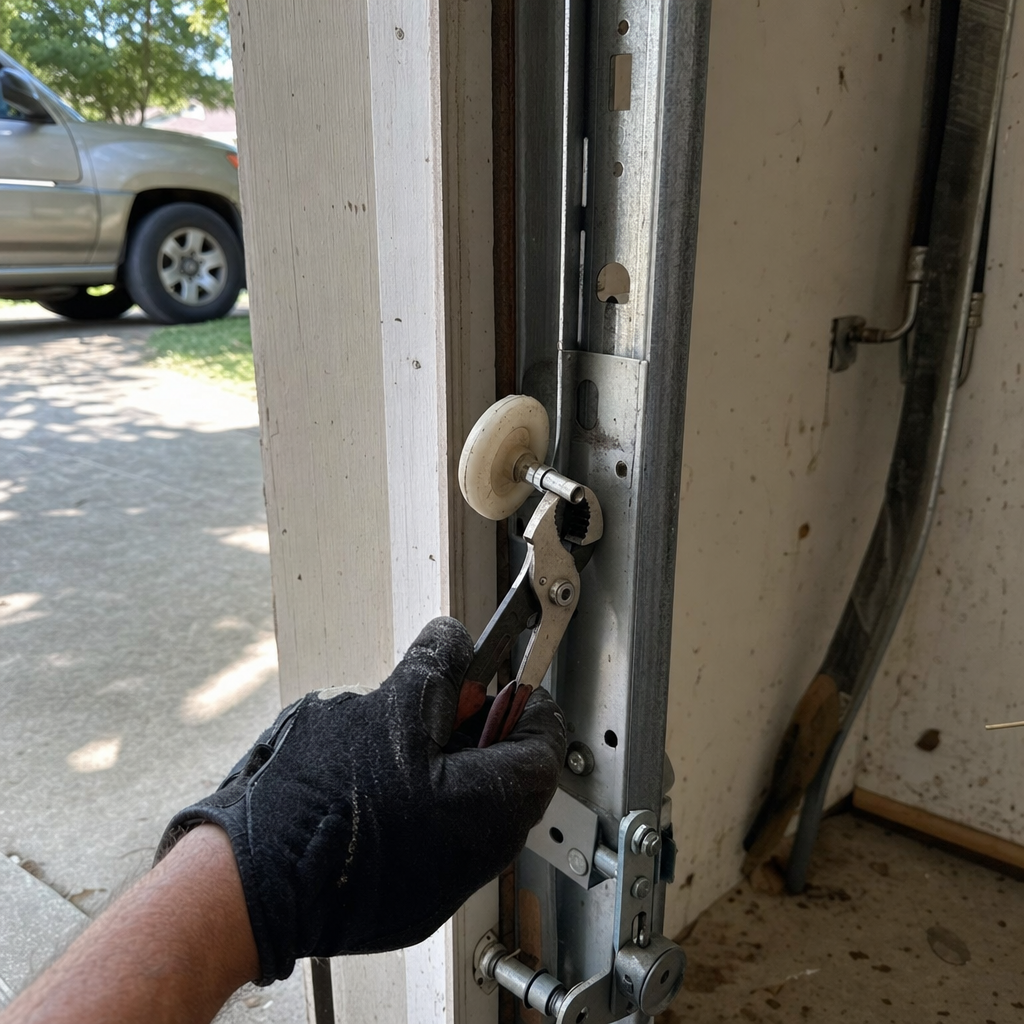
- Lubricate all rollers, hinges, and the torsion spring. If you haven’t lubricated since fall, now is the time — before the heat season begins drying everything out further.
Use a lithium-based spray lubricant, not WD-40. WD-40 is a water displacer, not a true lubricant, and it attracts dust in Austin’s cedar and oak pollen season, which gums up rollers faster than anything else we see in spring service calls.
June: Peak-Heat Hardening
By June, Austin’s garage doors are entering their most physically punishing period of the year. The south- and west-facing doors in neighborhoods like Avery Ranch, Circle C, and Bee Cave Road corridor absorb direct afternoon sun for six or more hours daily. Surface temperatures on a steel garage door facing west can exceed 150°F — well above the ambient air temperature — and that thermal stress cycles daily for four months straight.
Heat hardening means preparing your door for sustained high temperatures rather than reacting to the damage after summer ends. Here’s what to focus on in June:
- Inspect weatherstripping on all four sides. Rubber and vinyl seals harden and crack under repeated heat exposure. Once they crack, they’re no longer sealing — they’re just decorative strips. More on UV degradation specifically in the section below.
- Check the opener’s heat tolerance. LiftMaster and Chamberlain units mounted in uninsulated garages can see internal temperatures above 120°F. Some units have built-in thermal protection that shuts the motor down temporarily — that’s normal. But if your opener is cycling off repeatedly in early June, it may need relocation or a cooling upgrade before the worst of summer arrives.
- Evaluate your door’s insulation rating. An uninsulated single-layer steel door conducts heat directly into your garage, which raises the burden on your home’s HVAC if the garage is attached. Clopay and Amarr both offer polyurethane-injected panels with R-values of 12–18 that make a measurable difference in Austin’s climate.
- Lubricate again if spring application was light. Austin’s dry heat accelerates lubricant evaporation. Heavy-usage doors (three or more cycles per day) may need a mid-summer touch-up by July.
November: Freeze Prep
November is the most underappreciated maintenance window for Austin garage doors. The first freeze of the season doesn’t arrive gradually — it can drop from 68°F to 28°F in under 24 hours, which is exactly the scenario that snaps torsion springs that are already dry and fatigued from summer.
Torsion springs are under constant tension. When metal contracts rapidly in a sudden cold snap, a spring that’s been running without lubrication since summer is far more likely to fail than one that’s been properly maintained. In our experience, roughly 60–70% of the torsion spring replacements we handle in Austin occur between October and February — the cold snap window.
November prep checklist:
- Thoroughly lubricate the torsion spring, rollers, hinges, and tracks with a lithium or silicone-based lubricant. Don’t skip the spring itself — it’s the highest-fatigue component and the most expensive single-item repair on a residential door.
- Inspect the bottom seal for cracks and compression loss. Cold-hardened seals lose their ability to conform to uneven concrete floors. A failed bottom seal in a freezing garage allows cold air intrusion that can affect pipes in garages used for storage or utility space.
- Test the door balance manually. Disconnect the opener, lift the door to waist height, and let go. A balanced door stays put. One that falls or rises on its own has spring tension problems that will get worse as temperatures drop.
- Check the opener’s battery backup if your unit has one (most newer LiftMaster and Chamberlain models do). Austin’s ice storms frequently knock out power for 12–48 hours — February 2021 proved that — and a dead battery backup means a manually-operated door during the coldest conditions.
- Clear the door’s bottom edge of any debris or standing water. If water freezes under the bottom seal overnight, it can bond the door to the ground. Forcing a frozen door open is one of the fastest ways to strip a cable drum or damage the opener’s drive system.
February: Post-Freeze Check
February in Austin is when you audit the damage from whatever the winter delivered. Even if your door seemed to operate fine through the cold months, freeze-thaw cycling leaves behind problems that aren’t always obvious until spring load increases.
What to inspect after the freeze window closes:
- Look for hairline cracks in the bottom seal. These are easy to miss but will become full gaps by the time summer heat arrives.
- Inspect cable drums and lift cables for fraying. Cold-weather stress combined with a frozen-door event can cause micro-damage to cables that won’t fail immediately but will within 60–90 days.
- Check the spring for visible rust or corrosion. Austin’s winter moisture — especially in years with significant ice events — accelerates surface rust on torsion springs. A rusty spring is a spring with reduced fatigue life.
- Retest the door balance using the same manual test described in the November section. Spring tension can shift meaningfully across a cold season, and a re-balance now prevents opener strain heading into spring.
- Lubricate all moving parts again. The November application has been working for three months through cold, moisture, and thermal cycling. It’s time for a fresh coat before storm season prep begins in April.
February is also the right time to schedule a professional tune-up if any of the above items look concerning. That puts you ahead of the April rush that follows Austin’s first wave of storm damage calls.
UV Degradation: Austin’s Hidden Weatherstripping Problem
Most garage door maintenance content treats weatherstripping as a generic item — check it once a year, replace if cracked, done. That advice doesn’t account for what Austin’s UV index actually does to rubber and vinyl seals.
Austin sits at roughly 30° north latitude and receives an average UV index of 9–11 from May through September. Research on rubber polymer degradation indicates that high-UV climates accelerate weatherstripping breakdown at a rate approximately 40% faster than climates in the northern tier of the US. That means a seal that lasts eight years in Minneapolis may last four to five years in Austin — sometimes less on south- or west-facing doors with direct afternoon sun exposure.
Signs of UV-degraded weatherstripping to look for:
- Brittleness or visible cracking along the seal’s length, especially at the top corners where sun exposure is concentrated
- A “chalky” or whitened appearance on black rubber seals — this is UV-induced surface degradation
- Gaps visible at the door edges when the door is fully closed, even when the track alignment is correct
- Increased dust intrusion into a garage that was previously well-sealed
When replacing weatherstripping in Austin, look for seals specifically rated for high-UV environments. Wayne Dalton and Clopay both sell door-specific seal kits with UV-stabilized materials. Generic hardware store vinyl stripping degrades faster in Central Texas sun and tends to cost more in the long run through early replacement cycles.
The One Task After Every Major Temperature Swing
Austin is one of the few metro areas in the US that routinely sees temperature swings exceeding 30°F within a 48-hour window — sometimes in a single day. These swings happen most frequently in October–November and February–March, the shoulder seasons on either side of winter.
Rapid thermal expansion and contraction does something specific to garage door opener logic boards and their travel limit settings: it can cause the door’s stopping positions to drift. Metal rails expand in heat and contract in cold. An opener that was calibrated in summer to stop precisely at the floor may, after a sharp cold snap, stop two inches short — leaving a gap at the bottom seal that lets cold air, pests, and rain in. Or it may over-travel slightly and put unnecessary stress on the cables and spring assembly.
After any temperature swing of 30°F or more in 48 hours, do this one check:
- Operate the door through one full open-close cycle and watch the close position carefully.
- If the door stops more than an inch above the floor or if you hear the motor straining before it stops, the travel limits need adjustment.
- On most LiftMaster, Chamberlain, and Genie units, travel limit adjustment is a simple screw or button-based calibration accessible from the motor head — check your model’s manual for the specific procedure.
- If the door is stopping short repeatedly or reversing unexpectedly after a temperature swing, and the limits look correct, the issue may be with the force sensitivity settings on the opener — a common point of drift on older Craftsman and Raynor units after thermal cycling.
This two-minute check after a major temperature swing has prevented a lot of the “my opener just started acting weird in November” calls we get every year. It’s one of the most Austin-specific maintenance habits we recommend, precisely because no other major metro in Texas sees this swing pattern as frequently.
Common Mistakes to Avoid
- Using WD-40 as a garage door lubricant. WD-40 is a solvent and water displacer, not a load-bearing lubricant. In Austin’s pollen-heavy spring air, it creates a sticky residue on rollers and tracks that attracts debris and accelerates wear. Use white lithium grease or a silicone spray specifically labeled for garage doors.
- Ignoring the door balance test after summer. Many Austin homeowners skip this because the door “still opens fine.” A door that opens with opener assistance can be significantly out of balance — placing daily strain on the opener motor that shortens its lifespan by years.
- Waiting until after a freeze to lubricate. Lubricating a spring that’s already cold and under tension is better than nothing, but it doesn’t undo the micro-fatigue from months of dry cycling. November pre-freeze lubrication is what protects the spring through the cold snap, not emergency lubrication in January.
- Replacing weatherstripping with generic vinyl from a home improvement store. Standard vinyl strips are formulated for moderate climates. Austin’s UV exposure and temperature cycling will degrade them significantly faster than door-manufacturer seals rated for high-UV environments. The upfront cost savings typically disappear after one replacement cycle.
- Forcing a door open when it seems stuck in cold weather. If water has frozen under the bottom seal overnight — common in neighborhoods like Hyde Park and South Congress where older concrete slabs have surface irregularities that trap water — forcing the opener to break the ice bond can strip the cable drums or trigger a safety reversal fault that requires a reset. Break the ice manually first.
- Skipping the post-freeze cable inspection in February. Lift cables look fine until they don’t. A frayed cable that survives a freeze season often fails during the first high-usage week of spring when daily cycles increase. Catching it in February costs you a cable replacement. Missing it can drop a door on a vehicle or person.
- Assuming a new door doesn’t need seasonal maintenance. A newly installed door still needs its first annual lubrication, balance check, and hardware tightening within 12 months. New spring tension settles with use, and Austin’s first summer on a new door is often when fine-tuning is most needed.
When to Call a Professional
Some garage door maintenance is genuinely homeowner-friendly — lubrication, visual inspection, testing the auto-reverse safety feature. Other tasks carry real injury risk or require calibrated tools that make a professional call the right move.
Call a professional when you see or hear any of these:
- A loud bang from the garage — this almost always signals a broken torsion spring, which is under hundreds of pounds of stored tension and should never be replaced without proper winding bars and training.
- A cable that’s off the drum or visibly frayed — loose cables can snap without warning and will cause the door to drop suddenly.
- The door is moving unevenly, one side higher than the other during operation.
- The opener reverses immediately after you start a close cycle, or strains audibly during normal operation.
- Any hardware that was damaged during a storm, including bent tracks or a panel that took a direct hit.
Garage Door Repair in Austin from Total Garage Door Experts Austin comes with free estimates — Paul Martin and his team handle everything from broken springs to full replacements, with same-day service available for urgent situations. Call (737) 210-3210 to get an exact quote without any obligation.
Frequently Asked Questions
How often should I lubricate my garage door in Austin?
Austin garage doors should be lubricated at minimum twice per year: once in November before the first freeze window, and once in April before storm season. Doors that see three or more daily cycles — common in households where the garage is a primary entry point — benefit from a third application in July, when Austin’s dry heat accelerates lubricant evaporation faster than it would in a more humid climate. Use a white lithium grease or silicone-based spray on the torsion spring, rollers, hinges, and tracks. Call (737) 210-3210 if you’d prefer a professional lubrication and tune-up — it takes about 30 minutes and costs far less than a premature parts replacement.
What does a Central Texas freeze do to torsion springs?
A sudden freeze causes metal to contract rapidly, and torsion springs — which are already under significant stored tension — can snap when that contraction is rapid and the spring hasn’t been lubricated recently. Austin’s freeze pattern is more dangerous for springs than a northern climate’s gradual winter because the temperature drop happens so quickly, sometimes 35–40°F in under 24 hours. Springs that have been running dry through a five-month summer are especially vulnerable during that first November or December cold snap. Pre-freeze lubrication in November is the single most effective thing you can do to extend spring life in Central Texas.
How do I know if my garage door weatherstripping needs replacing in Austin?
In Austin, UV degradation is the primary failure mode for weatherstripping — more so than in most parts of the country. Look for brittleness, surface cracking, a chalky or faded appearance on black rubber seals, and visible light gaps around the door frame when the door is fully closed. South- and west-facing doors are most vulnerable due to direct afternoon sun. Austin’s UV exposure degrades standard weatherstripping roughly 40% faster than northern climates, so don’t assume a seal that looks “okay” is still sealing effectively. If it’s been more than four years on a sun-exposed door, it’s worth a hands-on inspection.
Can I prepare my garage door for Austin’s severe thunderstorms and high-wind events?
Yes — and pre-storm preparation is meaningfully different here than Gulf Coast hurricane prep. Austin’s severe storms are typically short-duration, high-intensity wind events (derechos and severe squall lines) with straight-line winds up to 70–75 mph. The key vulnerabilities are loose track mounting hardware, missing or stripped lag screws at the header bracket, and gaps in the bottom seal that allow wind-driven rain to enter at the floor. A full hardware tightening and track inspection in April — before the first serious storm window — is the most effective preparation. If your door has a manual lock bar, make sure it operates freely so you can secure the door mechanically during a power outage.
What should I check after Austin’s February ice storm season?
After the freeze window closes in February, inspect the bottom seal for new cracks (cold-hardening often causes subtle splitting that becomes a full failure in summer), check the lift cables for fraying or slack that developed during freeze-thaw cycling, look for surface rust on the torsion spring, and retest the door’s manual balance. February is also the right time for a fresh lubrication cycle before storm season prep begins. If your door was frozen to the ground at any point during winter — even briefly — inspect the cable drums for signs of slippage or deformation from a forced operation.
How much does a garage door tune-up cost in Austin?
A professional garage door tune-up in the Austin market typically runs $80–$150, depending on what’s included. A full tune-up should cover lubrication of all moving parts, hardware tightening, spring tension check, safety reversal test, travel limit inspection, and a visual assessment of weatherstripping and cables. That $80–$150 investment regularly prevents repairs in the $250–$600 range — a broken torsion spring alone runs $200–$380 in the Austin market including labor. Call Total Garage Door Experts Austin at (737) 210-3210 for a free estimate on a tune-up or any repair — there’s no charge just to get a number.
The Bottom Line
Austin garage doors operate under stresses that a generic seasonal checklist doesn’t account for: five months of intense UV and heat, two storm windows with short-notice high-wind events, and a freeze pattern that delivers thermal shocks rather than gradual seasonal transitions. The four-point maintenance calendar in this guide — April storm prep, June heat hardening, November freeze prep, and February post-freeze check — is built around what Austin’s climate actually does to hardware. Stay on that schedule, use the right lubricants, replace UV-degraded weatherstripping before it fails, and you’ll avoid the majority of the emergency calls Paul Martin and his team handle every year. When something does go beyond a homeowner tune-up, having a local specialist who knows your climate on speed dial makes all the difference.
For professional garage door service in Austin, including same-day repairs and free estimates, visit Total Garage Door Experts Austin home or explore options for a Garage Door Installation in Austin or a new Garage Door Opener in Austin. Paul and his team service all major brands — LiftMaster, Chamberlain, Genie, Clopay, Amarr, Wayne Dalton, Craftsman, and Raynor — and bring 12 years of Austin-specific field experience to every job. Call (737) 210-3210 to schedule service or get a free estimate.
Written by Paul Martin, Owner & Lead Technician at Total Garage Door Experts Austin, serving Austin since 2014.